
Land Buying Guide Western Kenya: Smart Steps for Secure Land Ownership
Buying land in Western Kenya can be one of the most rewarding investments — whether you’re seeking an omukunda (farm), residential plot, or a commercial property. But it also demands due diligence, local knowledge, and an understanding of county regulations.
This Land Buying Guide Western Kenya by Ewefu Hub helps you navigate the process from search to ownership — with local insights for Kakamega, Bungoma, Busia, Vihiga, and Trans Nzoia counties.
Step-by-Step Land Buying Process in Kenya (eCitizen-Integrated)
Step 1: Identify Your Target Area and Land Type
Start by defining your purpose — farming, residential, or business. Check accessibility, road quality, water, and electricity. Ewefu Hub recommends focusing on upcoming growth corridors such as:
- Kakamega–Mumias–Bungoma Road
- Busia–Malaba highway
- Chavakali–Kaimosi–Mbale–Kapsabet link road
Step 2: Conduct a Title Search on eCitizen
Forget old manual searches — eCitizen now hosts the National Land Information Management System (NLIMS) for all counties gradually being digitized.
How to do a title search online:
- Log in to eCitizen.go.ke
- Navigate to Ministry of Lands & Physical Planning
- Select Land Search
- Enter the parcel number (from the title deed or sale offer)
- Pay Ksh 500
- Download your official Title Search Certificate
✅ Why this matters: It verifies the true owner, title authenticity, and any encumbrances (charges, caveats, disputes).
Step 3: Site Visit and Boundary Verification
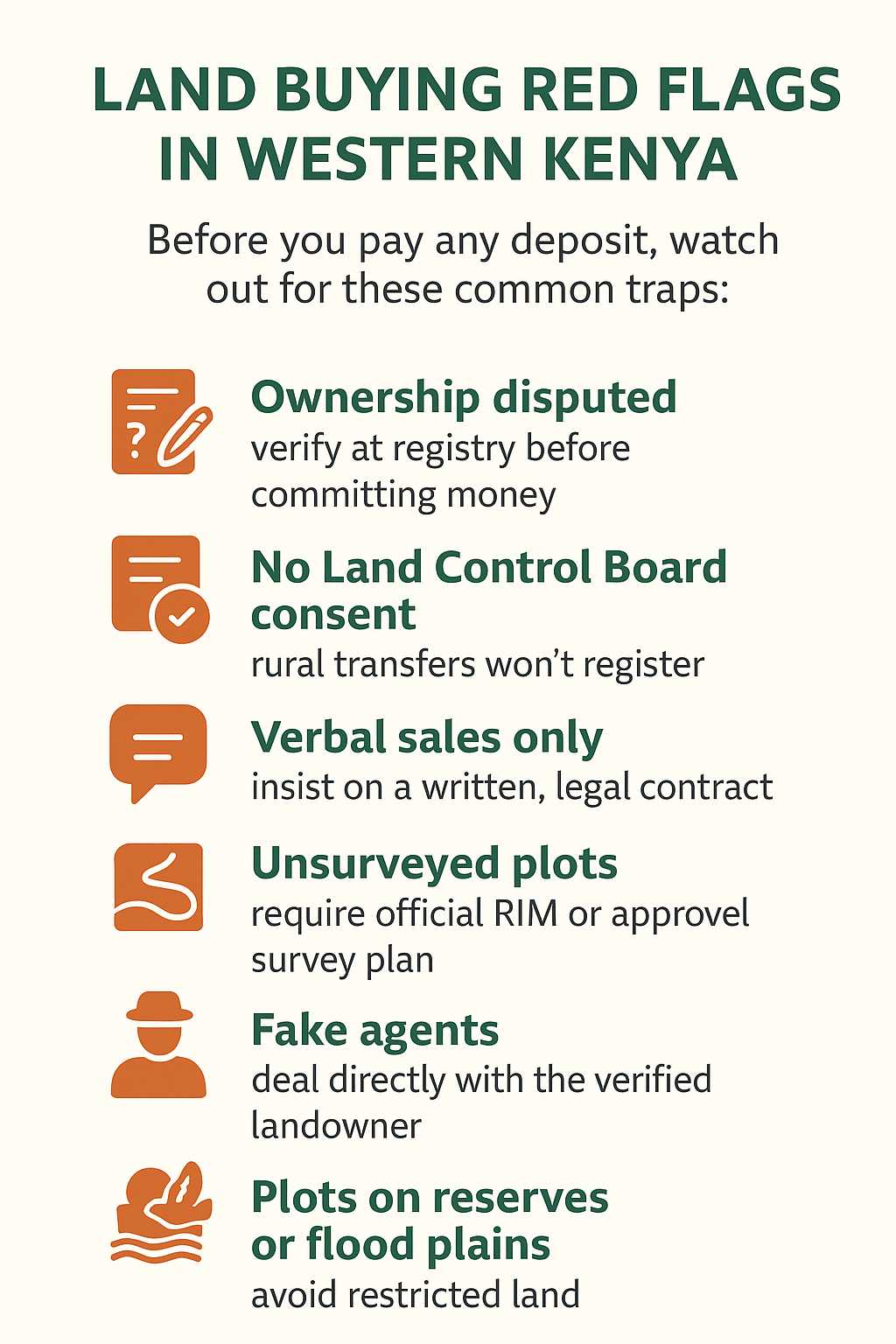
Physically visit the plot. Walk boundaries with the owner and area chief. Use a licensed surveyor to confirm beacons match the Registry Index Map (RIM).
🧩 Pro Tip: Avoid “verbal sellers.” Insist on viewing the original title deed and seller’s ID.
Step 4: Land Control Board (LCB) Consent
All agricultural land in Western Kenya requires LCB consent before transfer. Apply through your sub-county office.
Documents needed:
- Sale agreement
- Title copy
- ID & KRA PIN
- Consent application form
🕐 The LCB meets monthly. Without consent, any transaction is void under Kenyan law (Cap 302).
Step 5: Drafting & Signing Sale Agreement
Use a licensed advocate to prepare the agreement — outlining parties, price, deposit, timelines, and responsibilities.
⚖️ Stamp duty: 4% (urban) or 2% (rural) of property value.
Step 6: Land Transfer via eCitizen
- Log in to eCitizen > Ministry of Lands > Transfer of Ownership
- Upload scanned documents (title, consent, sale agreement)
- Pay stamp duty online
- Await digital approval from Registrar
You’ll then receive your new digital title deed through your eCitizen account.
Step 7: Possession & Fencing
After registration, take possession immediately. Fence and install visible boundary markers.
Ewefu Hub tip: Record a short handover video and keep all documents scanned and stored in Google Drive for safekeeping.
For a step-by-step Land Buying Process in Kenya, see our related post: Land Buying Guide
Strategic Investment Opportunities (County-by-County Insights)
Kakamega County
Focus Areas: Kakamega Town, MMUST, Mumias, Malava
- Opportunities: Student rentals near MMUST, small gated estates, mixed-use properties.
- Drivers: University expansion, better roads, and growing middle-income population.
- Risks: Poor drainage in low-lying zones, unclear campus zoning, encroachments.
- Tip: Ideal for first-time buyers seeking steady rental income or quick resale.
Bungoma County
Focus Areas: Webuye, Bungoma Town, Kibabii
- Opportunities: Industrial plots, hostels, small commercial hubs.
- Drivers: Kibabii University, Webuye industrial revival.
- Risks: Informal land subdivisions, weak road access in rural zones.
- Tip: Check zoning with the county to ensure compliance before construction.
Busia County
Focus Areas: Busia Town, Malaba, Nambale
- Opportunities: Warehouse yards, truck parking, border trade investments.
- Drivers: Malaba OSBP, cross-border logistics, SGR corridor expansion.
- Risks: Flood-prone zones near River Sio, fake land agents.
- Tip: Prioritize land near tarmac roads for logistics; check encumbrances carefully.
Vihiga County
Focus Areas: Mbale, Chavakali, Kaimosi
- Opportunities: Scenic residential estates, small hotels, student rentals.
- Drivers: Kaimosi University, beautiful hilly landscapes.
- Risks: Sloping terrain requiring retaining walls, erosion-prone plots.
- Tip: Great for investors seeking vacation homes or serene countryside living.
Trans Nzoia County
Focus Areas: Kitale, Endebess
- Opportunities: Agri-estates, farmhouses, commercial maize ventures.
- Drivers: Fertile soils, irrigation potential, strategic link to Western markets.
- Risks: Cooperative lease issues, land control restrictions.
- Tip: Do a soil test before purchase — ideal for agribusiness and farm stays.
Land Buying Guides by County in Western Kenya
If you’re planning to invest across the Western region, Ewefu Hub has prepared detailed county-specific land buying price guides…

How to Buy Land in Western Kenya (Quick 7-Step Plan)
- Choose your preferred county and identify your plot purpose.
- Conduct a title search on eCitizen for authenticity.
- Visit the site, confirm boundaries, and engage a licensed surveyor.
- Apply for Land Control Board consent.
- Sign a sale agreement through a registered lawyer.
- Transfer ownership digitally via eCitizen.
- Fence and take possession promptly.
Strategic Investment Opportunities
| County | Emerging Areas | Ideal Investment Type | Key Drivers | Red Flags |
|---|---|---|---|---|
| Kakamega | Mumias, Malava | Rentals, estates | University growth | Poor drainage |
| Bungoma | Webuye, Kibabii | Industrial, hostels | Factory revival | Informal titles |
| Busia | Malaba, Nambale | Logistics, warehouses | Border trade | Flood zones |
| Vihiga | Chavakali, Mbale | Residential, hotels | Scenic value | Steep terrain |
| Trans Nzoia | Kitale, Endebess | Agri-estates | Fertile soils | Lease restrictions |
Ready to Buy or Sell Land in Western Kenya?
Ewefu Hub verifies titles, arranges surveys, and connects you to vetted vendors.
Best Practices When Buying Land in Western Kenya
- Always transact through a licensed advocate.
- Avoid paying cash — use traceable bank transfers.
- Visit the Chief’s office to confirm no family disputes.
- Confirm plot accessibility and utilities before payment.
- Record the entire process digitally (receipts, IDs, GPS location).
Frequently Asked Questions (FAQs)
Q1: Can I buy land in Western Kenya as a non-resident?
Yes. Foreigners and Kenyans abroad can purchase land, but agricultural plots must be leased (not freehold).
Q2: How do I confirm a genuine title deed?
Use eCitizen’s title search, match seller ID and title number, and verify signatures at the Lands Registry.
Q3: What is LCB consent and why is it important?
The Land Control Board approves agricultural land transfers. Without LCB consent, the transaction is void.
Q4: How long does transfer take?
Digital transfers via eCitizen take 7–14 working days, faster than old manual systems.
Q5: What documents should I retain?
Keep title deed, sale agreement, LCB consent, payment receipts, and ID/KRA copies.
Comments